

LinkedIn has evolved into one of the most powerful B2B lead generation platforms in the world. With over a billion professionals using the platform, sales teams, founders, recruiters, agencies, and consultants rely on LinkedIn to identify decision-makers and build meaningful business relationships.
However, as competition increases, manual outreach is becoming less effective. Sending individual connection requests, remembering follow-ups, tracking responses, and managing conversations manually can quickly consume hours of productive time every week.
This is where LinkedIn outreach sequences become essential.
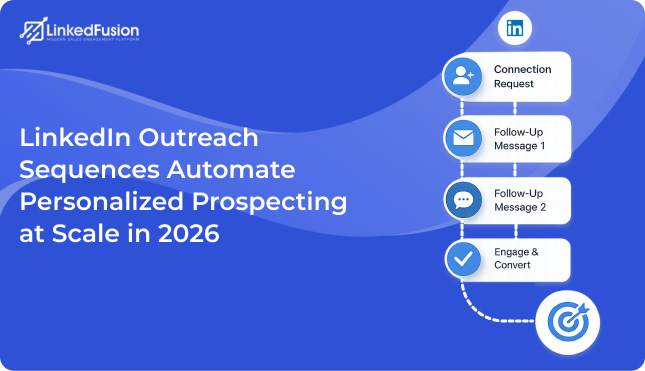
A LinkedIn outreach sequence allows businesses to automate prospecting activities while maintaining personalization throughout the buyer journey. Instead of manually tracking hundreds of prospects, outreach sequences automatically guide prospects through a structured communication workflow designed to increase engagement and generate qualified meetings.
In this guide, you’ll learn everything about LinkedIn outreach sequences, including how they work, why they’re important, best practices, common mistakes, key metrics, and how businesses can scale prospecting efficiently in 2026.
What Are LinkedIn Outreach Sequences?
LinkedIn outreach sequences are automated workflows that perform a series of predefined actions based on prospect behavior.
Rather than sending messages manually, businesses create sequences that automatically trigger actions such as:
- Sending connection requests
- Waiting for connection acceptance
- Sending personalized follow-up messages
- Delivering nurture messages
- Tracking responses
- Managing prospect engagement
These workflows help sales teams stay consistent while reducing manual effort.
A typical sequence might look like this:
Day 1: Send personalized connection request
Day 3: Prospect accepts request
Day 4: Send introduction message
Day 7: Follow-up with value-driven content
Day 12: Send case study or resource
Day 18: Request a discovery call
Instead of manually managing every step, the sequence handles the process automatically.
Why LinkedIn Outreach Sequences Matter in 2026
Modern buyers are overwhelmed with sales messages.
Research consistently shows that prospects rarely respond to first-touch messages. Most conversations happen after multiple touchpoints.
Without a structured system, businesses often:
- Forget follow-ups
- Lose qualified leads
- Create inconsistent prospect experiences
- Waste sales resources
- Miss revenue opportunities
LinkedIn outreach sequences solve these challenges by ensuring every prospect receives timely and relevant communication.
Benefits include:
Increased Productivity
Sales representatives can focus on conversations instead of repetitive tasks.
Consistent Follow-Ups
Every prospect receives the correct message at the right time.
Higher Response Rates
Personalized sequences typically generate better engagement than generic outreach.
Better Lead Management
Teams can organize prospects based on engagement and buying intent.
Scalability
Businesses can reach larger audiences without significantly increasing workload.
How LinkedIn Outreach Sequences Work
A successful LinkedIn outreach process consists of several stages.
Step 1: Build a Targeted Prospect List
Successful outreach starts with targeting.
Prospects should be selected based on:
- Industry
- Company size
- Revenue
- Job title
- Seniority level
- Geographic location
- Business challenges
The more relevant your audience, the better your campaign performance.
Step 2: Send Personalized Connection Requests
Connection requests are your first impression.
Avoid generic messages such as:
“Hi, I’d like to connect.”
Instead, reference something specific:
- Mutual interests
- Industry trends
- Shared communities
- Relevant content
Personalization increases acceptance rates significantly.
Step 3: Automated Follow-Up Messaging
After a connection is accepted, automated follow-ups keep the conversation moving.
The goal isn’t to sell immediately.
The goal is to build trust.
Effective follow-ups include:
- Helpful resources
- Industry insights
- Case studies
- Thought leadership content
- Relevant observations
Step 4: Monitor Engagement
Track:
- Connection acceptance rates
- Response rates
- Meeting bookings
- Campaign engagement
Performance data helps optimize future sequences.
Step 5: Optimize Continuously
Analyze:
- Which messages generate replies
- Which industries engage most
- Which sequences drive meetings
Small optimizations can dramatically improve campaign results.
Components of a High-Converting LinkedIn Outreach Sequence
Personalized Connection Request
This establishes initial contact.
Welcome Message
Introduces yourself and creates context.
Value-Based Follow-Up
Provides educational content without selling.
Social Proof Message
Highlights customer results or case studies.
Meeting Request
Invites prospects to continue the conversation.
LinkedIn Outreach Sequence Example
Day 1
Connection Request:
“Hi Sarah, noticed we’re both working in SaaS growth. I’d love to connect and follow your insights.”
Day 3
Thank You Message:
“Thanks for connecting. I’ve been following trends around outbound automation recently and found some interesting patterns.”
Day 6
Value Message:
“One thing we’re seeing is that personalized outreach consistently outperforms generic campaigns. Curious if you’re seeing similar results.”
Day 10
Case Study Message:
“We recently helped a team improve reply rates by optimizing sequence timing and personalization.”
Day 15
Meeting Invitation:
“If improving outreach performance is currently a priority, happy to exchange ideas.”
Best Practices for LinkedIn Outreach Automation
Prioritize Personalization
Automation should support personalization, not replace it.
Segment Your Audience
Different audiences require different messaging.
Keep Messages Short
Concise messages generally perform better.
Focus on Conversations
Avoid immediate sales pitches.
Use Human Language
Write naturally.
Avoid robotic messaging.
Test Different Sequences
Experiment with:
- Message length
- Timing
- Call-to-actions
- Personalization approaches
Common LinkedIn Outreach Mistakes
Sending Generic Messages
Generic outreach lowers acceptance and response rates.
Following Up Too Frequently
Over-messaging can damage credibility.
Ignoring Prospect Intent
Not every prospect is ready to buy.
Using Aggressive Sales Tactics
LinkedIn is relationship-driven.
Failing to Track Metrics
Without data, optimization becomes impossible.
Key Metrics to Track
Connection Acceptance Rate
Measures connection request effectiveness.
Reply Rate
Tracks message engagement.
Positive Response Rate
Measures qualified conversations.
Meeting Booking Rate
Evaluates conversion performance.
Lead-to-Customer Conversion Rate
Measures overall campaign success.
LinkedIn Outreach Automation vs Manual Outreach
| Factor | Manual Outreach | Automated Outreach |
|---|---|---|
| Scalability | Low | High |
| Follow-Up Consistency | Limited | Excellent |
| Time Efficiency | Low | High |
| Reporting | Difficult | Easy |
| Prospect Management | Manual | Automated |
The ideal strategy combines automation with personalization.
Choosing the Right LinkedIn Prospecting Tool
When evaluating a LinkedIn prospecting tool, consider:
- Outreach sequence builder
- Campaign automation
- Inbox management
- Lead organization
- Analytics dashboard
- Account warm-up capabilities
- Multi-step workflows
A comprehensive platform should help sales teams manage the entire prospecting process from prospect discovery to conversation management.
How LinkedFusion Helps Businesses Scale Outreach
LinkedFusion simplifies LinkedIn prospecting through:
- Automated outreach sequences
- Connection request automation
- Prospect management
- Unified inbox management
- Campaign analytics
- Performance reporting
- Account warm-up features
By combining automation with personalization, LinkedFusion enables businesses to generate more conversations while reducing manual workload.
The Future of LinkedIn Outreach
As LinkedIn becomes more competitive, successful outreach will rely on three factors:
- Better targeting
- Higher personalization
- Smarter automation
Businesses that adopt structured outreach sequences today will be better positioned to generate predictable pipeline growth in the coming years.
Final Thoughts
LinkedIn outreach sequences are no longer optional for businesses that rely on outbound prospecting.
They provide a scalable framework for building relationships, maintaining follow-ups, and generating qualified opportunities without overwhelming sales teams.
When implemented correctly, LinkedIn outreach automation allows businesses to reach more prospects, improve response rates, and create a repeatable lead generation system that drives long-term growth.
For teams looking to scale LinkedIn prospecting efficiently, a structured outreach sequence combined with the right automation platform can become one of the most effective growth channels available in 2026.
FAQs
A LinkedIn outreach sequence is a series of planned interactions designed to engage prospects over time. Instead of sending a single message, businesses create multiple touchpoints that may include connection requests, follow-up messages, value-driven content, and meeting invitations. The goal is to build trust and increase the chances of starting meaningful business conversations.
Most successful LinkedIn outreach campaigns use 3 to 5 touchpoints over 10 to 14 days. Sending too many follow-ups can appear spammy, while stopping after one message often leaves opportunities untapped. The ideal approach is to provide value in each follow-up rather than repeatedly asking for a meeting.
Yes, LinkedIn outreach remains one of the most effective B2B prospecting channels in 2026. However, generic mass messaging is becoming less effective. Personalized, signal-based outreach that references a prospect’s activity, challenges, or interests continues to generate strong response rates.
The most effective strategy combines audience targeting, personalized connection requests, value-based follow-ups, and consistent engagement. Businesses that focus on relationship building rather than immediate selling typically achieve higher response and conversion rates.
A typical LinkedIn outreach sequence lasts between 10 and 21 days. Most replies occur during the first few touchpoints, so the emphasis should be on quality and relevance rather than the number of messages sent.
A good connection request should be short, relevant, and personalized. Mention a shared interest, industry trend, mutual connection, or something specific about the prospect’s profile. Avoid sales pitches in the initial request and focus on starting a professional relationship.
LinkedIn outreach automation refers to the use of software tools to automate repetitive prospecting tasks such as connection requests, follow-ups, prospect management, and campaign tracking. Automation helps sales teams scale outreach while maintaining consistency.
To improve response rates, focus on personalization, audience segmentation, concise messaging, and value-driven communication. Referencing a prospect’s recent activity or business challenge often performs significantly better than generic templates.
While results vary by industry and audience, many successful outreach campaigns aim for connection acceptance rates between 25% and 40%. Highly personalized outreach can often exceed these benchmarks.
The most important metrics include:
Connection Acceptance Rate
Response Rate
Positive Reply Rate
Meeting Booking Rate
Opportunity Conversion Rate
Revenue Generated
Tracking these KPIs helps identify which sequences and messages generate the best results.
Yes. LinkedIn is widely used by decision-makers, founders, executives, recruiters, and business professionals. A well-structured outreach sequence can consistently generate qualified leads, meetings, partnerships, and sales opportunities.
Both channels can be effective. LinkedIn outreach often creates warmer conversations because prospects can view your profile and establish trust before responding. Many high-performing teams combine LinkedIn outreach with cold email as part of a multi-channel prospecting strategy.
You can personalize outreach at scale by segmenting prospects, using dynamic variables, referencing industry-specific pain points, and tailoring messages based on job roles. The goal is to make each prospect feel that the message was written specifically for them.
Common mistakes include:
Sending generic messages
Pitching too early
Following up excessively
Targeting the wrong audience
Ignoring campaign analytics
Failing to personalize outreach
Avoiding these mistakes can significantly improve campaign performance and response rates.