
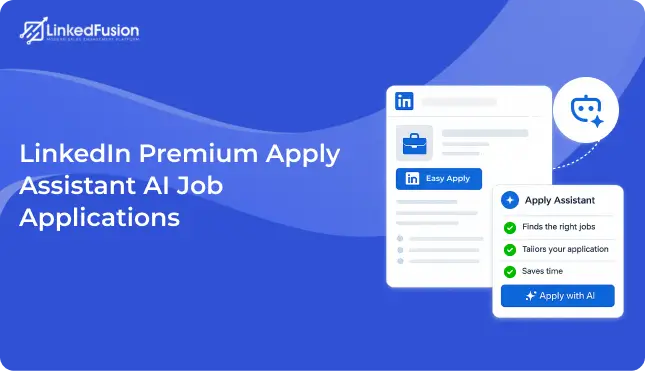

Artificial intelligence is transforming nearly every aspect of professional networking and recruitment, and LinkedIn is taking another major step in that direction.
The platform has introduced Premium Apply Assistant, an AI-powered feature designed to simplify the job application process for LinkedIn Premium members. Instead of manually filling out applications for every opportunity, users can now receive AI assistance that helps identify suitable roles, pre-fill application details, and even generate personalized cover letters.
LinkedIn continues to expand its AI capabilities, and the launch of Premium Apply Assistant is another step toward an AI-first professional platform. While this feature is designed primarily for job seekers, it reflects a much broader trend: LinkedIn is increasingly using artificial intelligence to simplify repetitive tasks, improve productivity, and enhance the user experience. For professionals, recruiters, sales teams, and businesses, this launch offers valuable insight into where LinkedIn is heading next.
In this article, we’ll explore how LinkedIn Premium Apply Assistant works, its key features, advantages, potential drawbacks, and what this innovation means for both applicants and hiring teams.
Table of Contents
What Is LinkedIn Premium Apply Assistant?
How Does LinkedIn Premium Apply Assistant Work?
Key Features of Premium Apply Assistant
Benefits for Job Seekers
What Does This Update Mean for the Future of LinkedIn?
Potential Challenges Recruiters May Face
Best Practices for Using AI in Job Applications
Will AI Replace Traditional Job Applications?
Frequently Asked Questions
Final Thoughts
What Is LinkedIn Premium Apply Assistant?
LinkedIn Premium Apply Assistant is an AI-powered job application assistant built exclusively for LinkedIn Premium subscribers.
Its purpose is straightforward: reduce the repetitive work involved in applying for multiple jobs while helping applicants present stronger, more complete applications.
Rather than asking users to repeatedly enter the same employment history, education, certifications, and skills, the assistant leverages information from a member’s LinkedIn profile and combines it with artificial intelligence to automate much of the application process.
The assistant can:
Recommend jobs that closely match a user’s experience
Pre-fill application forms
Suggest improvements where information may be missing
Generate customized cover letter drafts
Provide confidence indicators that estimate whether each section of the application is ready for submission
One particularly interesting capability is that the assistant isn’t limited to jobs posted directly on LinkedIn. It can also assist with supported external job applications, making it useful across a broader range of hiring platforms.
The feature reflects a growing trend in AI-assisted productivity, where technology helps users complete repetitive tasks faster while leaving the final review and approval in human hands.
How Does LinkedIn Premium Apply Assistant Work?
At its core, Premium Apply Assistant uses artificial intelligence together with the information already available on your LinkedIn profile.
Here’s a simplified overview of the workflow.
Step 1: AI Evaluates Your Profile
The assistant analyzes your:
Work experience
Skills
Certifications
Education
Career progression
Industry expertise
This information becomes the foundation for future applications.
Step 2: It Identifies Relevant Opportunities
Instead of searching manually through hundreds of listings, the assistant highlights positions where your profile appears to match the employer’s requirements.
This helps users prioritize opportunities that align with their qualifications.
Step 3: AI Pre-Fills Application Forms
Many job applications require candidates to repeatedly enter identical information.
Premium Apply Assistant reduces this manual effort by automatically completing supported fields using information from your LinkedIn profile.
Examples include:
Previous employers
Job titles
Educational qualifications
Skills
Contact information
The result is a significantly faster application process.
Step 4: AI Generates a Cover Letter
One of the most talked-about features is AI-generated introductory letters.
Instead of writing every cover letter from scratch, applicants receive a draft tailored to the specific role.
The user can:
Edit the content
Add personal achievements
Remove unnecessary information
Customize the tone
Approve the final version
LinkedIn states that recruiters only see the final application submitted by the candidate—not whether AI was used to help create it.
Step 5: Confidence Indicators
Before submitting, the assistant reviews different sections of the application.
Each section receives a confidence indicator showing how complete or ready it appears based on LinkedIn’s AI assessment.
This helps applicants identify areas that may need improvement before sending their application.
Key Features of LinkedIn Premium Apply Assistant
LinkedIn’s newest AI feature introduces several capabilities designed to simplify job applications while improving efficiency.
Let’s look at each one.
1. AI-Powered Job Recommendations
Instead of browsing endless listings, users receive recommendations based on profile relevance, experience, and qualifications.
This makes job discovery faster and more targeted.
2. Automatic Form Filling
Repeatedly entering the same employment history is one of the most frustrating parts of online applications.
Premium Apply Assistant automates much of this work by using existing profile data wherever supported.
The result is fewer manual inputs and quicker submissions.
3. AI-Generated Cover Letters
Writing unique cover letters can be time-consuming, especially for professionals applying to multiple roles.
The assistant creates an initial draft that users can personalize before submitting.
This reduces writer’s block while still allowing candidates to maintain control over the final version.
4. Application Readiness Score
The confidence indicators help applicants understand whether sections of their application appear complete.
Rather than guessing if something has been overlooked, users receive AI-powered guidance before applying.
5. Support Beyond LinkedIn Jobs
Unlike many platform-specific tools, Premium Apply Assistant also supports compatible applications outside LinkedIn.
This expands its usefulness for professionals exploring opportunities across multiple hiring platforms.
Benefits for Job Seekers
The introduction of AI into job applications offers several practical advantages.
Saves Significant Time
Professionals often apply to dozens of roles before receiving interviews.
Automating repetitive fields can save hours every week, allowing candidates to focus on preparing for interviews instead of completing duplicate forms.
Reduces Application Fatigue
Repeatedly writing the same information becomes mentally exhausting.
AI minimizes repetitive work while maintaining consistency across applications.
Helps Less Experienced Candidates
Graduates and first-time job seekers often struggle with writing effective cover letters.
AI-generated drafts provide a useful starting point that users can refine with their own experiences and personality.
Encourages Complete Applications
Incomplete applications frequently reduce a candidate’s chances of progressing.
Confidence indicators remind users to review missing information before submission, potentially improving application quality.
Makes Premium More Valuable
LinkedIn Premium has traditionally offered benefits such as InMail credits, applicant insights, and advanced profile visibility.
Premium Apply Assistant adds another productivity-focused feature that could make the subscription more attractive for active job seekers.
What Does This Update Mean for the Future of LinkedIn?
This is where opinions begin to differ.
From the applicant’s perspective, AI simplifies repetitive tasks and lowers the barrier to applying for more opportunities.
However, recruiters may see a different picture.
If thousands of candidates begin using AI to generate polished applications, resumes and cover letters may become increasingly similar. The personal voice that once helped candidates stand out could be replaced by standardized AI-generated language.
This shift raises important questions for the future of recruitment:
Will recruiters receive significantly more applications?
Will identifying genuinely qualified candidates become more difficult?
Will interviews carry even greater importance than resumes?
Will hiring teams develop new methods to distinguish authentic communication from AI-assisted writing?
These are challenges that both employers and technology platforms will likely continue addressing as AI becomes more deeply integrated into recruitment.
In the next section, we’ll examine the potential risks of AI-assisted job applications, how recruiters may adapt, and the best practices candidates should follow to use tools like Premium Apply Assistant responsibly.
Potential Risks and Limitations of LinkedIn Premium Apply Assistant
While LinkedIn Premium Apply Assistant offers clear productivity benefits, it also introduces new challenges for both job seekers and recruiters. Like any AI-powered tool, its effectiveness depends on how responsibly it’s used.
1. Increased Competition for Every Job
One of the biggest concerns is that AI significantly lowers the effort required to apply for a role.
Instead of spending 15–20 minutes completing each application, candidates may be able to submit several applications in just a few minutes. This convenience could lead to a substantial increase in the number of applications recruiters receive.
For employers, that means sorting through a much larger applicant pool, making it harder to identify the most qualified candidates.
2. Generic Cover Letters
Although AI-generated cover letters provide a useful starting point, they shouldn’t replace personal input.
Recruiters often look for signs that a candidate understands the company, the role, and its challenges. A generic AI-generated letter may fail to communicate genuine interest or demonstrate why the applicant is uniquely qualified.
The best approach is to use AI as a drafting assistant rather than submitting the generated content unchanged.
3. Risk of Inaccurate Information
AI relies heavily on the information available in your LinkedIn profile.
If your profile is outdated, incomplete, or contains inaccuracies, those issues may carry over into your job applications. That’s why keeping your profile current is more important than ever.
Before using any AI-assisted application tool, make sure your:
Job titles are accurate
Employment dates are up to date
Skills reflect your current expertise
Certifications are current
Achievements include measurable results whenever possible
4. Less Personal Storytelling
Employers don’t hire resumes—they hire people.
A compelling application often includes personal experiences, career motivations, and accomplishments that demonstrate authenticity.
While AI can organize information effectively, it cannot fully capture your personality, ambition, or career journey unless you take the time to personalize its suggestions.
How Recruiters May Adapt to AI-Generated Applications
As AI becomes more common in recruitment, hiring teams will likely adjust their evaluation methods.
Rather than relying solely on resumes and cover letters, recruiters may place greater emphasis on:
Live interviews
Skills-based assessments
Work samples and portfolios
Technical or practical evaluations
Behavioral interview questions
Reference checks
Recruiters may also spend more time reviewing LinkedIn profiles, recommendations, project portfolios, and professional activity to better understand a candidate beyond the application itself.
In many ways, AI could shift hiring toward a more holistic evaluation process, where demonstrated skills and real-world experience carry greater weight than polished written applications.
Best Practices for Using LinkedIn Premium Apply Assistant
AI should help you work smarter—not replace your judgment.
To get the most value from LinkedIn Premium Apply Assistant, follow these best practices.
Keep Your LinkedIn Profile Updated
Since the assistant uses your profile to populate applications, accuracy is essential.
Review your profile regularly and ensure it reflects your latest experience, accomplishments, certifications, and skills.
Always Review AI-Generated Content
Never submit an application without reading it carefully.
Check for:
Incorrect information
Missing achievements
Generic language
Formatting issues
Company-specific details
A few minutes of editing can significantly improve the quality of your application.
Personalize Every Cover Letter
Recruiters appreciate applicants who demonstrate genuine interest in the role.
Add details about:
Why you’re interested in the company
Relevant projects you’ve worked on
Industry knowledge
Specific achievements that match the job requirements
These additions make your application feel authentic and memorable.
Focus on Quality Over Quantity
Just because AI makes it easier to apply doesn’t mean you should apply to every available position.
Target roles that genuinely match your experience, skills, and career goals. Well-tailored applications often outperform a large number of generic submissions.
Will AI Replace Traditional Job Applications?
Probably not.
Instead, AI is likely to become another productivity tool—similar to spell checkers, grammar assistants, or resume builders.
Candidates will still need to:
Build strong professional experience
Develop valuable skills
Prepare for interviews
Demonstrate communication abilities
Showcase problem-solving capabilities
AI can improve efficiency, but it cannot replace genuine expertise or professional credibility.
As hiring evolves, employers will continue looking beyond resumes to evaluate whether someone is the right fit for their organization.
What This Means Beyond Job Seekers
LinkedIn’s introduction of Premium Apply Assistant signals a broader shift in how AI is being integrated across professional workflows.
We’re already seeing AI assist with:
Writing LinkedIn posts
Drafting messages
Candidate sourcing
Content creation
CRM data management
For professionals who use LinkedIn daily, AI is becoming less of an optional add-on and more of an integrated productivity assistant.
Businesses, recruiters, and sales teams should expect AI-powered features to continue expanding across the platform.
The LinkedFusion Perspective
LinkedIn Premium Apply Assistant is more than a new Premium feature—it’s part of a larger transformation happening across the platform.
As LinkedIn continues investing in artificial intelligence, users can expect more automation, smarter recommendations, and AI-powered assistance across networking, recruiting, sales, and content creation.
At LinkedFusion, we believe AI should empower professionals by reducing repetitive work while leaving important decisions in human hands. The most successful users won’t rely entirely on AI—they’ll combine automation with authentic communication, strategic thinking, and meaningful relationship building.
Staying informed about LinkedIn’s latest innovations allows professionals and businesses to adapt faster and make better use of the platform as it evolves.
FAQs
No. Premium Apply Assistant is currently available to LinkedIn Premium subscribers as part of LinkedIn’s premium offering.
Yes. The assistant can generate a cover letter draft based on your profile and the job description. You can edit and customize it before submitting your application.
According to LinkedIn, recruiters only see the final application you choose to submit. The platform does not indicate whether AI assisted in creating the application.
LinkedIn has stated that the feature can assist with supported external job applications by pre-filling compatible application fields and generating cover letter drafts.
No.
AI should be treated as an assistant rather than a replacement for your own review. Always verify details, personalize your application, and ensure everything accurately represents your experience.
Yes. Over the past few years, LinkedIn has introduced AI-powered tools for writing, learning, recruiting, sales, and now job applications, indicating a long-term investment in AI across its platform.
Final Thoughts
LinkedIn Premium Apply Assistant marks another important step in the evolution of AI-powered professional networking.
For job seekers, it promises a faster and more efficient application process by reducing repetitive tasks, generating cover letter drafts, and helping users prepare stronger applications.
For recruiters, however, it introduces new challenges around application volume, authenticity, and candidate evaluation.
Ultimately, AI should be viewed as a productivity partner—not a replacement for thoughtful communication, genuine experience, and professional preparation.
The candidates who combine AI efficiency with authentic storytelling, relevant skills, and careful personalization are likely to stand out the most in an increasingly AI-assisted hiring landscape.
As LinkedIn continues integrating AI across its ecosystem, professionals who understand how to use these tools responsibly will be better positioned to adapt to the future of work.
Stay Ahead of Every LinkedIn Update with LinkedFusion
LinkedIn continues to introduce AI-powered features that reshape how professionals network, recruit, sell, and grow their careers. Staying informed about these updates helps individuals and businesses make smarter decisions and maximize the platform’s potential.
At LinkedFusion, we regularly share expert insights, LinkedIn feature updates, automation strategies, sales outreach best practices, and productivity tips to help professionals get more from LinkedIn.
Whether you’re a recruiter, sales professional, entrepreneur, marketer, or job seeker, following the latest LinkedIn innovations can help you stay competitive in an AI-driven professional landscape.